
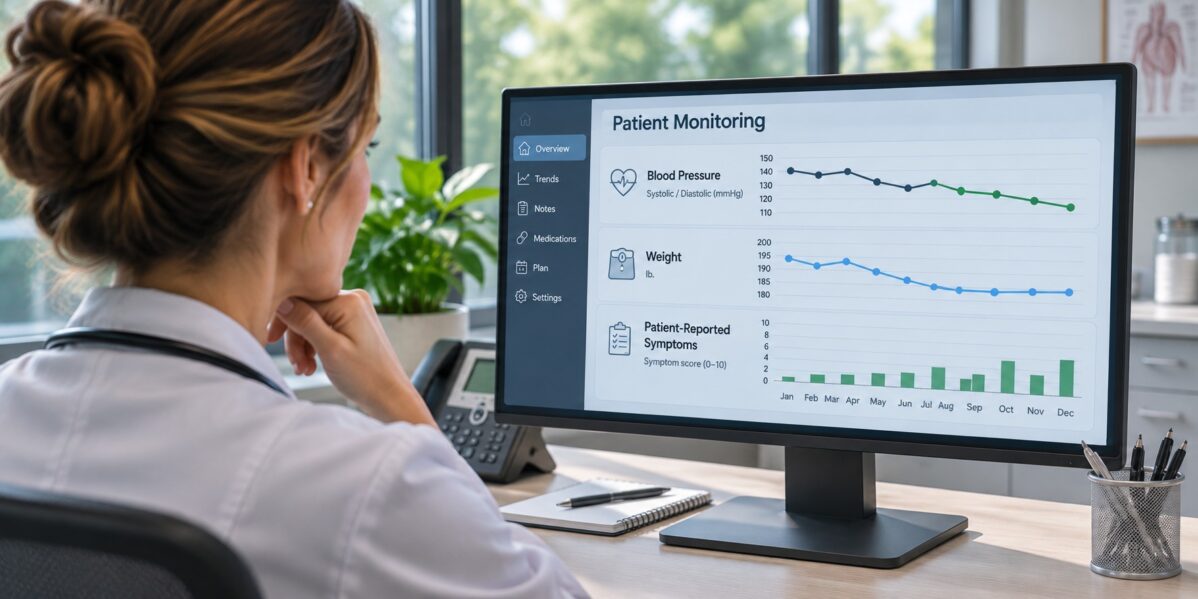
Why Consistent Patient Data is Critical for Better Outcomes
We know that a patient’s health does not remain static between office visits. Blood pressure fluctuates, symptoms change, and complications can develop long before the next scheduled appointment.
Yet many clinical decisions rely heavily on information collected during periodic visits, sometimes weeks or months apart.
Consistent patient data helps close this information gap. In this context, it means relevant health measurements and patient-reported information collected at clinically appropriate intervals and reviewed over time, not simply a higher volume of readings.
The goal is not simply to collect more information. It is to ensure the right information reaches the right clinical professional at the right time.
In Part 1 of our Coordinated Care Series, we explored the importance of clinical alignment and coordinated care. In Part 2, we examined how dedicated clinical teams improve patient outcomes while reducing provider burden.
In this final installment, we’ll examine how consistent patient data connects these elements to support better clinical decisions, earlier intervention, and potentially lower healthcare costs.
What You’ll Learn
- Why consistent patient data matters: How regularly collected health information provides valuable context for clinical decisions.
- How proactive care can improve outcomes and manage costs: Why identifying concerning trends earlier may help prevent complications and reduce avoidable healthcare utilization.
- How data becomes actionable: The importance of connecting patient monitoring with dedicated clinical teams and coordinated care programs.
Seeing Beyond the Office Visit
A blood pressure reading taken during an appointment provides valuable information, but it represents a single point in time.
What if that patient’s blood pressure has been gradually increasing over several weeks? Or what if a patient with heart failure has experienced changes in weight and increased shortness of breath since their last visit?
Without additional information, these changes may go unnoticed until symptoms worsen.
Through Remote Patient Monitoring (RPM), healthcare teams can gain greater visibility into relevant physiologic measurements, including blood pressure, blood glucose, weight, heart rate, and blood oxygen saturation.
Combined with patient-reported symptoms, medication adherence information, and other relevant clinical details, these measurements help establish a more complete picture of patient health.
The value comes from recognizing meaningful changes over time, not collecting isolated readings.
How Consistent Patient Data Improves Clinical Decisions
Regularly collected patient information can help clinical teams identify concerning trends, assess treatment effectiveness, and determine when additional follow-up may be appropriate.
Research demonstrates the potential value of incorporating home monitoring data into treatment decisions.
In the TASMINH4 randomized controlled trial, published in The Lancet, 1,182 adults with poorly controlled hypertension were assigned to usual care, home blood pressure self-monitoring, or self-monitoring with telemonitoring.
At 12 months, adjusted systolic blood pressure was 4.7 mmHg lower in the telemonitoring group than in the usual-care group when home readings were used to guide medication adjustments. Self-monitoring without telemonitoring also improved blood pressure compared with usual care.
These findings highlight the importance of making patient-generated information available for clinical decision-making. The benefit comes from using the data to guide appropriate care—not technology alone.
What RemetricHealth’s Patient Data Shows
RemetricHealth’s own patient outcomes analysis provides another example of the value of sustained monitoring.
In a longitudinal analysis of 50 patients with blood pressure readings in both Month 1 and Month 14 of a RemetricHealth-supported RPM program, average blood pressure decreased from approximately 139/78 mmHg to 128/74 mmHg.
Over those 14 months, the 50 patients generated 23,482 blood pressure readings, allowing changes in patient health to be evaluated over time.
Among 21 patients who began with systolic blood pressure of 140 mmHg or higher, average systolic blood pressure decreased by approximately 20 mmHg.
These results reflect an observational analysis comparing patients with their own baseline measurements, not a randomized controlled trial or a separate matched control group. While they do not establish that RPM alone caused the improvements, they demonstrate meaningful changes observed during participation in a sustained monitoring and care-management program.
Explore the full outcomes analysis in Part 1 of our Coordinated Care Series.
How Consistent Patient Data Can Help Manage Healthcare Costs
Poorly controlled chronic conditions can contribute to preventable complications, emergency department visits, and hospitalizations.
When consistent patient information is paired with timely clinical review, care teams may recognize emerging concerns earlier and help prevent some avoidable utilization.
Better information can also help practices allocate clinical resources more effectively, directing additional outreach toward patients who demonstrate concerning trends or need more support.
However, cost-effectiveness and cost savings are not the same thing.
Cost-effectiveness considers whether improved health outcomes justify the resources invested in a program. Cost savings occur when total expenditures actually decrease.
A systematic review of 16 studies published in JAMA Network Open found that home blood pressure monitoring demonstrated potential long-term cost-effectiveness compared with traditional office-based monitoring, particularly when combined with additional clinical support or team-based care.
These findings support the economic value of appropriate monitoring programs but do not establish that every program will generate net savings.
Actual financial outcomes depend on patient populations, program costs, clinical workflows, and whether monitoring and intervention reduce downstream healthcare utilization.
Turning Patient Data into Clinical Action
Access to patient data alone does not guarantee better care. Without established workflows, additional information can create more work for providers.
An effective coordinated care model connects monitoring with a repeatable clinical process:
- Collect: Patients submit relevant health measurements at clinically appropriate intervals.
- Review: Qualified clinical team members evaluate readings, trends, and other relevant patient information.
- Engage: Clinical teams contact patients when appropriate to assess concerns, reinforce education, or identify barriers to care.
- Escalate: Significant findings are communicated to the provider according to established clinical protocols.
- Follow up: Clinical teams reinforce care plans and evaluate ongoing patient progress.
This structured approach helps ensure that patient information contributes to care decisions while allowing providers to focus on issues requiring their clinical expertise.
Connecting Patient Data Through RPM, CCM, and APCM
RemetricHealth helps healthcare organizations connect patient monitoring with dedicated nursing support through complementary care-management services.
- Remote Patient Monitoring (RPM) provides physiologic measurements that help clinical teams evaluate patient health between appointments.
- Chronic Care Management (CCM) supports patients through regular communication, education, and personalized care-plan management.
- Advanced Primary Care Management (APCM) emphasizes comprehensive primary care coordination, preventive services, and addressing gaps in care.
Depending on patient needs and applicable program requirements, these services can complement one another to support more proactive, patient-centered care.
RemetricHealth’s nurse-led approach helps practices turn patient information into meaningful clinical support without placing every monitoring and follow-up responsibility on internal staff.
Bringing Coordinated Care Together
Throughout this three-part series, we’ve explored the essential components of effective coordinated care:
Clinical alignment establishes the plan.
Dedicated clinical care teams provide ongoing support.
Consistent patient data helps guide informed clinical action.
Together, these elements support a more proactive approach to chronic disease management—one designed to improve outcomes, make better use of clinical resources, and potentially reduce avoidable healthcare costs.
RemetricHealth helps practices bring these components together through integrated RPM, CCM, and APCM services supported by experienced nursing professionals.
Schedule a conversation with RemetricHealth to learn how we can help your organization deliver more connected, proactive patient care.
FAQ
What is consistent patient data in chronic disease management?
Consistent patient data refers to relevant health measurements and patient-reported information collected at clinically appropriate intervals. Reviewing this information over time helps providers identify trends that may not be visible during individual appointments.
Can consistent patient monitoring lower healthcare costs?
Potentially. Monitoring combined with appropriate clinical intervention may reduce avoidable complications and healthcare utilization. Research also supports the long-term cost-effectiveness of certain home monitoring approaches, although actual savings depend on program performance and costs.
How do RPM, CCM, and APCM support data-driven coordinated care?
RPM provides relevant physiologic measurements, while CCM and APCM support different aspects of ongoing care management and coordination. Together, when appropriately implemented, these services can help clinical teams use patient information to guide outreach and support more informed care decisions.
Explore the Complete Coordinated Care Series
- Part 1: Why Move to Coordinated Care?
- Part 2: How Clinical Care Teams Improve Patient Outcomes While Reducing Provider Burden
- Part 3: Why Consistent Patient Data Is Critical for Better Outcomes
Leave A Comment