
Why Move to Coordinated Care?
Managing a patient’s chronic disease rarely comes down to a single office visit, medication, or clinical decision.
Between visits, patients can become confused about their care plan, forget to take medications or take them inconsistently, develop additional complications such as depression, miss an appointment, or fail to follow through with a referral. Without the support that older patients and others living with chronic conditions may need between visits, a lot can happen.
The challenge is that traditional healthcare delivery is often organized around individual encounters. Weeks or months may pass before the next appointment.
Meanwhile, the patient’s condition continues to evolve.
Coordinated care helps close this gap by connecting the provider’s treatment plan with ongoing patient monitoring, structured clinical support, and communication among everyone involved in the patient’s care.
Evidence increasingly supports this connected, team-based approach to chronic disease management. The key, however, is not simply adding more technology, collecting more data, or creating more patient touchpoints. Better coordination depends on putting all of these elements into a clinical workflow where information can lead to appropriate action.
What You’ll Learn:
In this article, we’ll explore:
- What coordinated care means for chronic disease management
- Why clinical alignment is essential for effective care management
- How consistent monitoring improves visibility between office visits
- How integrated clinical care teams can extend a provider’s ability to support patients
- What research tells us about the potential impact of team-based and remotely monitored care
This is Part 1 of our Coordinated Care Series.
What is Coordinated Care?
The Agency for Healthcare Research and Quality describes care coordination as deliberately organizing patient-care activities and sharing information among everyone involved in a patient’s care to achieve safer and more effective care. AHRQ identifies activities such as care management, medication management, monitoring and follow-up, proactive care planning, information sharing, and patient self-management support as important components of coordinated care.
For chronic disease management, this means the different parts of patient care should not operate independently.
The provider establishes the treatment plan and clinical goals. The care team helps reinforce that plan. Monitoring gives the team greater visibility into what is happening between visits. When appropriate, changes can be identified and escalated back to the provider.
The goal is not simply more patient contact or more data. It is connecting the right information to the right clinical resources at the right time.
This requires three components working together: clinical alignment, consistent monitoring, and an integrated care team.
1. Clinical Alignment Creates a Shared Plan
Coordination begins with everyone working from the same clinical direction.
The physician or other qualified provider establishes treatment goals, medications, monitoring requirements, and parameters for escalation. The supporting clinical team then works within that framework.
That can include defining:
- Which health indicators should be monitored
- When patient outreach is appropriate
- What constitutes a concerning change
- When findings should be escalated
- How patient interactions are documented
- How treatment plans are reinforced between appointments
Without this alignment, chronic care can become fragmented. Information may not reach the appropriate people, patients may receive inconsistent guidance, and important changes between appointments may be missed.
For practices building these programs, defined responsibilities and repeatable clinical workflows are critical. RemetricHealth explores these operational requirements further in Best Practices to Operationalize Care Management.
2. Consistent Monitoring Adds Visibility Between Visits
Clinical alignment establishes the plan.
Monitoring helps show what is actually happening.
A blood-pressure reading taken during an office appointment is valuable, but it represents a single moment. Regular measurements collected over time can reveal whether a patient’s blood pressure is improving, remaining stable, or trending in the wrong direction.
The same principle can apply to weight, blood glucose, oxygen saturation, heart rate, and other relevant physiologic indicators.
Through Remote Patient Monitoring (RPM), connected devices can give care teams greater visibility into patient health between visits. RemetricHealth’s RPM program includes biometric monitoring and clinical support from its nursing staff.
External research supports the value of connecting monitoring with additional clinical support. The Community Preventive Services Task Force recommends self-measured blood-pressure monitoring combined with additional support, which can include counseling, education, communication with providers, and team-based care.
This distinction is important.
For a closer look at ongoing patient data, read How Consistent Monitoring Improves Chronic Care Outcomes.
The measurement itself is not the complete intervention. Its value increases when the information reaches a clinical team that can evaluate it and act when appropriate.
What RemetricHealth’s Own Patient Data Shows
Recent RemetricHealth outcomes data provide a practical example of what sustained monitoring can look like in an active RPM population.
The overall program dataset included 90 unique patients and more than 33,000 blood-pressure readings. To better evaluate change over time, RemetricHealth created a matched cohort rather than comparing different patients at different stages of the program. Patients were compared with their own Month 1 baseline.
Among the 50 patients who remained in the program for at least 14 months, average blood pressure improved from approximately 139/78 mmHg in Month 1 to 128/74 mmHg in Month 14. The improvement occurred early and remained lower over the 14-month period. The matched cohort generated 23,482 blood-pressure readings during Months 1 through 14.
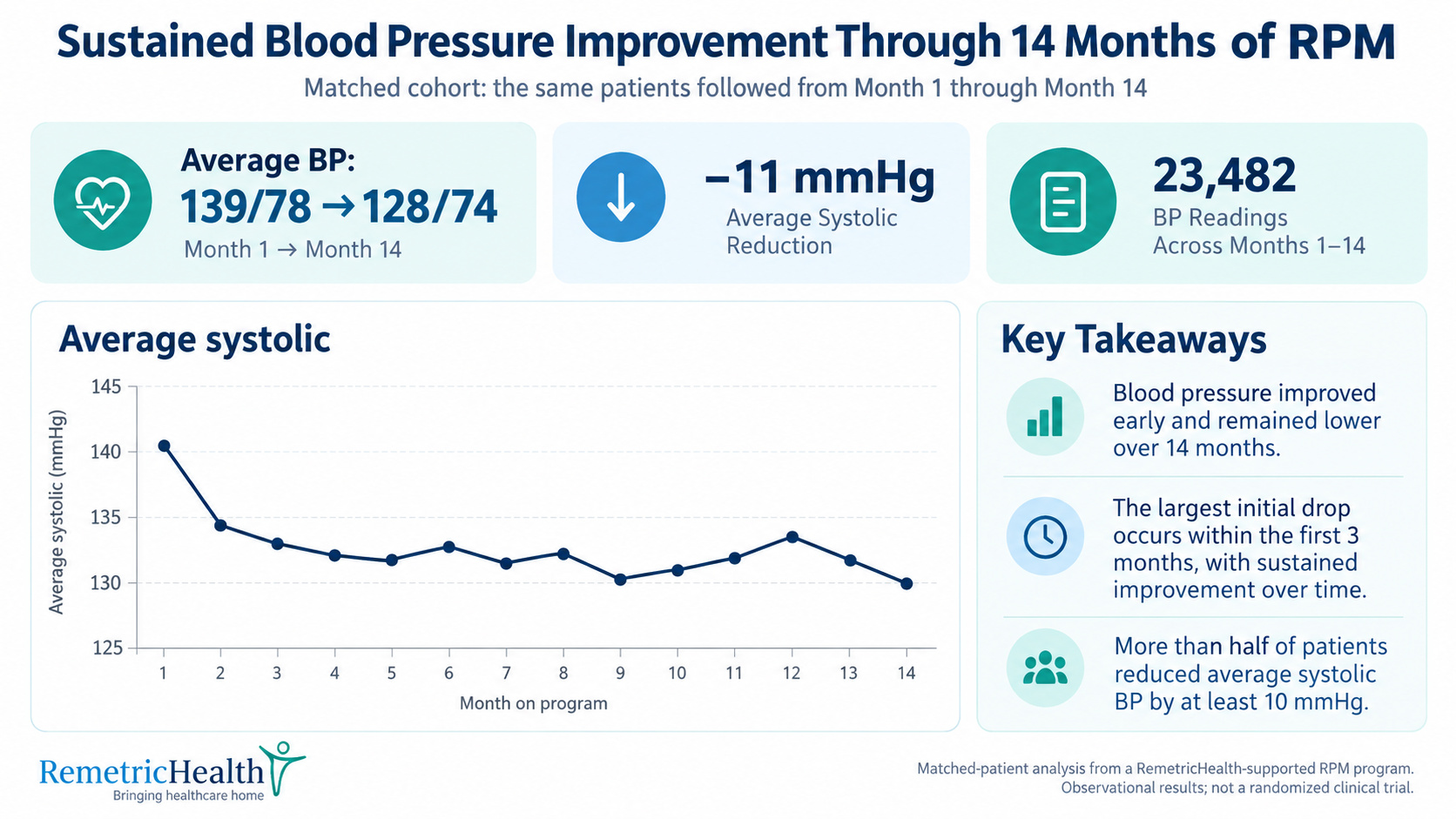
Systolic blood pressure was lower than the Month 1 baseline at every major follow-up point:
- Month 3: 5.9 mmHg lower among 74 matched patients
- Month 6: 6.7 mmHg lower among 60 patients
- Month 9: 9.1 mmHg lower among 57 patients
- Month 12: 7.9 mmHg lower among 54 patients
- Month 14: 11.0 mmHg lower among 50 patients
Patients Starting with Higher Blood Pressure Improved the Most
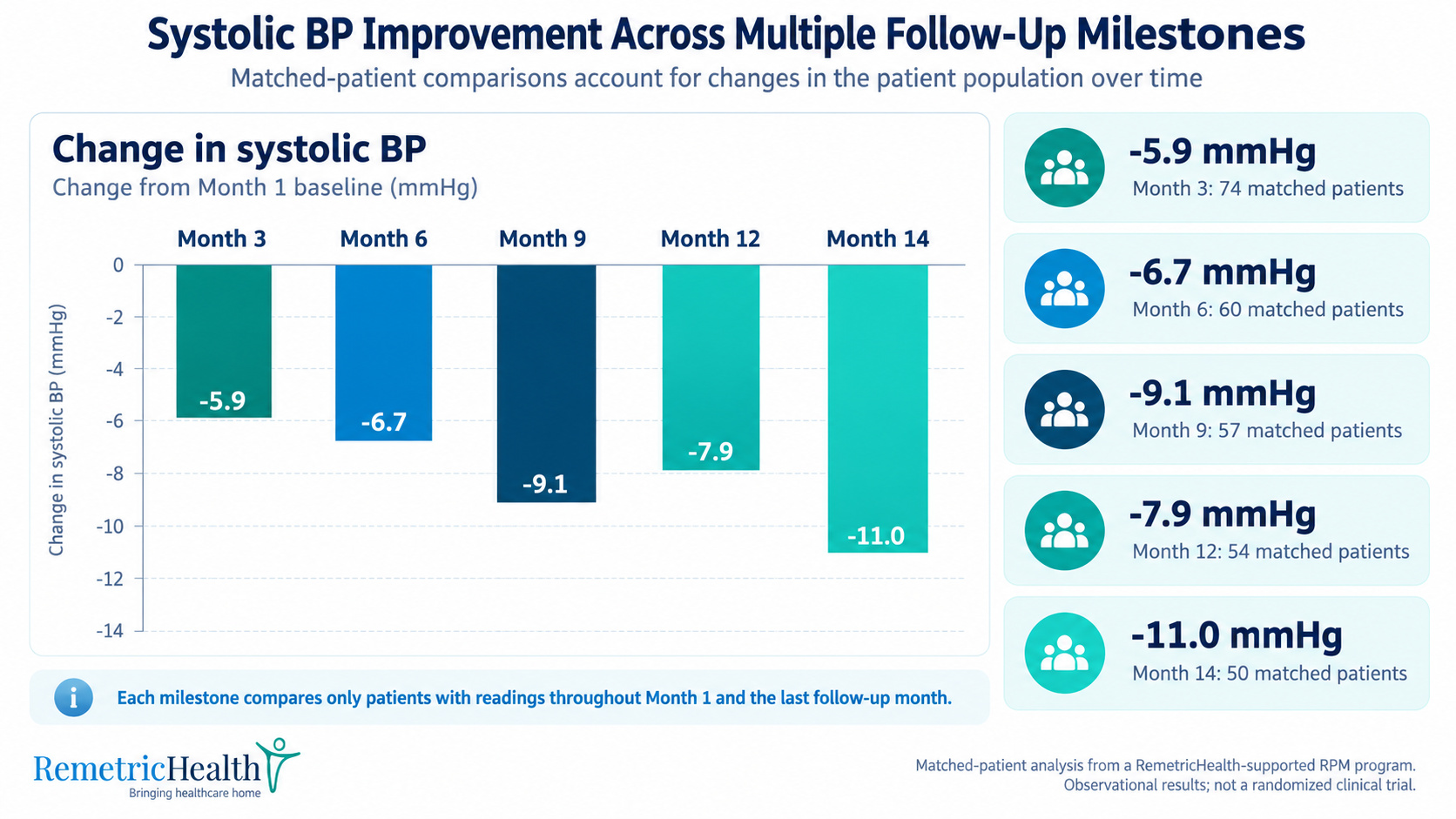
The largest improvement was observed among patients who entered the matched cohort with elevated systolic blood pressure.
Among 21 patients who started at 140 mmHg or higher, average systolic blood pressure decreased from approximately 152 mmHg to 132 mmHg over 14 months—a reduction of about 20 mmHg.
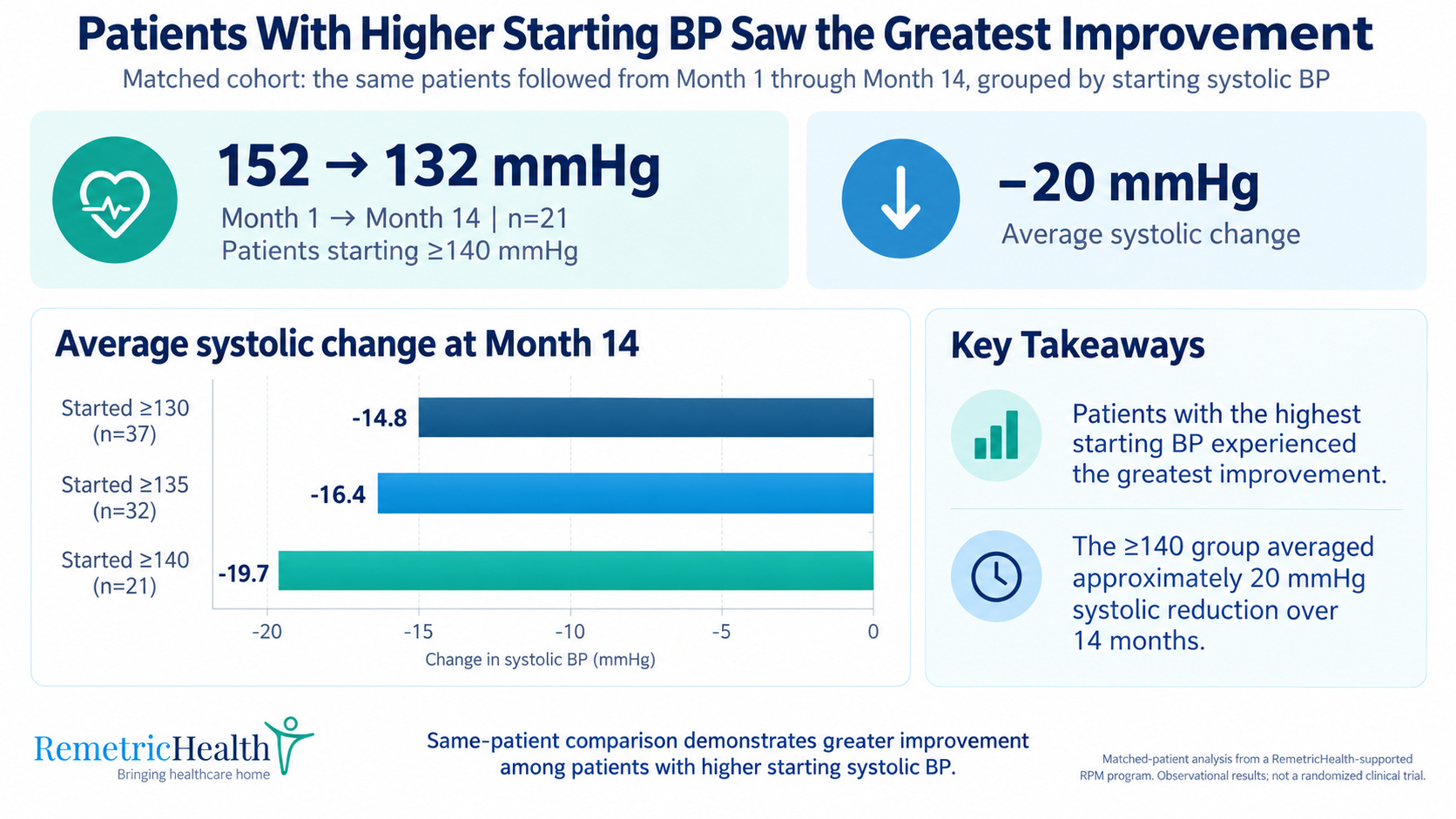
These results represent an observational analysis of patients participating in a RemetricHealth-supported RPM program, not a randomized clinical trial.
What the data does demonstrate is that sustained patient monitoring paired with an ongoing care-management program was associated with meaningful and persistent improvements in blood pressure among this patient cohort.
That is exactly where coordinated care becomes important.
Collecting readings creates visibility. The clinical workflow determines what happens next.
3. Integrated Clinical Teams Turn Information Into Action
Providers cannot personally perform every activity needed to support a large population of patients with chronic disease between visits.
A coordinated model distributes appropriate responsibilities across the clinical team while keeping the provider informed when clinical decision-making is required.
Depending on the care model, nurses and other care-management professionals can help:
- Monitor relevant patient information
- Communicate with patients
- Reinforce the care plan
- Support medication adherence
- Provide education
- Identify barriers to care
- Document interactions
- Escalate significant clinical concerns
Evidence supports team-based approaches. The Community Preventive Services Task Force recommends team-based care to improve blood-pressure control. These teams can include the patient, primary-care provider, nurses, pharmacists, dietitians, social workers, community health workers, and other professionals who share appropriate responsibilities for follow-up and chronic disease management.
The same principle is built into RemetricHealth’s Chronic Care Management program, where dedicated clinical staff provide regular communication, personalized care-plan support, education, and assistance between office visits.
Closing the Gap Between Visits
When these three components work together, coordinated care creates a continuous loop:
Treatment Plan → Patient Monitoring → Clinical Review and Outreach → Provider Escalation When Needed → Ongoing Care
The provider establishes the clinical direction.
Monitoring provides visibility.
The clinical care team maintains the connection with the patient.
And meaningful changes can reach the provider rather than waiting until the next scheduled appointment.
This is an important distinction because technology alone is not coordinated care.
The real value comes from connecting technology, patient information, clinical staff, and the provider within one organized care process.
For patients with chronic conditions, that can mean more support during the weeks or months when they would otherwise be largely on their own.
For providers, it can create a more scalable way to extend care beyond the office without personally managing every routine monitoring and follow-up activity.
And for the healthcare system, it provides a framework for moving from isolated encounters toward more continuous, proactive chronic disease management.
RemetricHealth’s recent blood-pressure data provide a real-world example of what that model can look like over time: consistent monitoring, sustained participation, and measurable improvement among patients who remained engaged in the program.
In Part 2 of this series, we’ll look more closely at the human component of this model: how clinical care teams can improve patient support and outcomes while reducing the amount of routine care-management work placed directly on providers.
To learn how coordinated RPM and care-management services can extend chronic care beyond the office, schedule a conversation with RemetricHealth.
FAQ
What is coordinated care?
Coordinated care connects a patient’s treatment plan, clinical team, monitoring information, communication, and follow-up so that everyone involved in care is working toward shared clinical goals.
Why is coordinated care important for chronic disease?
Chronic conditions require ongoing management between office visits. Coordinated care helps maintain communication, monitoring, patient support, and appropriate follow-up during the time patients spend outside the practice.
How does Remote Patient Monitoring support coordinated care?
RPM provides physiologic health information from outside the office. When that information is connected to a clinical workflow, care teams can identify trends, communicate with patients, and escalate significant findings when appropriate.
Does patient monitoring alone improve outcomes?
Monitoring alone does not guarantee improved outcomes. Its clinical value depends on factors such as patient engagement, consistent use, appropriate review, clinical support, and the actions taken when meaningful changes are identified.
How do clinical care teams support providers?
Clinical care teams can handle appropriate monitoring, routine outreach, education, care-plan reinforcement, documentation, and follow-up while escalating issues that require provider review or clinical decision-making.
Leave A Comment